




New Zealand’s Most Accessible Glacier
Franz Josef Glacier is a 12-kilometre river of ice flowing from the Southern Alps down to approximately 300 metres above sea level — one of the most accessible glaciers in the temperate world and one of only three glaciers on earth that descend into temperate rainforest. The glacier is located in Westland Tai Poutini National Park on the West Coast of New Zealand’s South Island, approximately 5 hours’ drive south of Greymouth and 4.5 hours northwest of Queenstown.
The glacier’s accessibility is what makes it extraordinary. Most glaciers of comparable size exist at high altitude in remote mountain environments. Franz Josef descends to within a short walk or helicopter flight of the small township that bears its name — a village of approximately 400 residents built entirely around glacier tourism. The combination of ice, rainforest, mountain scenery, and ease of access draws approximately 700,000 visitors annually.
How to Experience the Glacier
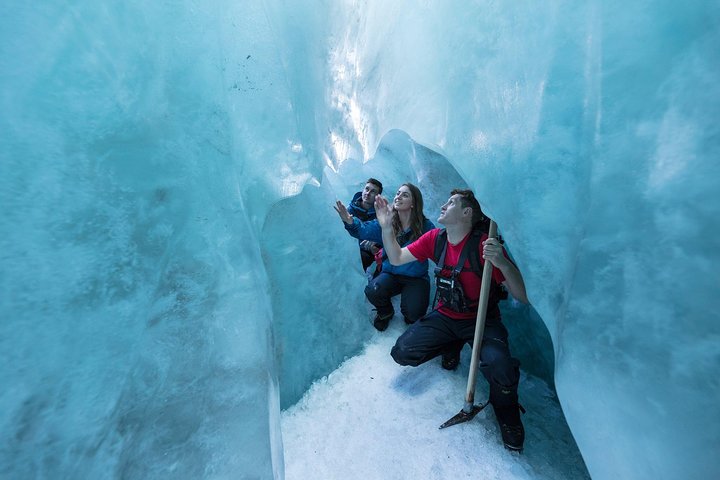
Heli-hike tours (covered in their own section) are the definitive Franz Josef experience — a helicopter flight onto the glacier’s upper reaches, followed by a 2–4 hour guided walk on the ice with crampons, exploring ice caves, seracs (ice towers), crevasses, and the blue-ice formations that the glacier’s compression creates. This is the only way to walk on Franz Josef Glacier since the terminal face became inaccessible on foot.
Helicopter scenic flights (covered separately) overfly the glacier without landing, providing the aerial perspective — the full length of the glacier from its névé (snow accumulation zone) high in the Alps to its terminal face in the valley below, with views of Mount Cook/Aoraki and Mount Tasman on clear days.
Snow landing flights (covered separately) land on the glacier’s upper snowfield — you step out onto the snow, walk around the landing zone, and photograph the alpine environment without the extended hike.
The Franz Josef Glacier Valley Walk is a free, self-guided walk from the village to a viewpoint overlooking the glacier’s terminal face — approximately 1.5 hours return on a well-maintained track through the rainforest and across the river flats. The walk does not reach the ice (the glacier has retreated significantly and the terminal face is unstable), but the viewpoint provides a clear view of the glacier snout and the valley it has carved.
The Glacier’s Retreat
Franz Josef Glacier has been retreating since the early 2000s after a period of advance in the 1980s and 1990s. The terminal face is now inaccessible on foot — the valley between the viewing platform and the ice is unstable, and the ice face calves unpredictably. This is why the heli-hike has become the primary glacier experience: the helicopter accesses the stable upper glacier where guided walking on the ice is safe and spectacular, bypassing the dangerous lower reaches entirely.
The retreat is visible — historical photographs and markers along the valley walk show where the glacier extended in previous decades, and the distance between the current terminal face and these markers is a striking visual demonstration of glacial retreat.
Practical Tips
Weather determines everything. The West Coast receives approximately 5,000 mm of rainfall annually (among the wettest places in New Zealand), and cloud cover can ground helicopter flights at short notice. Franz Josef averages approximately 180 rain days per year. If your glacier experience depends on a helicopter (heli-hike, scenic flight, snow landing), build flexibility into your schedule — allow at least two days in the area so that a weather cancellation on day one can be rescheduled on day two. Operators offer free rebooking or refunds for weather cancellations.
Book the heli-hike as early as possible. The heli-hike is capacity-limited (helicopter seats and guide ratios) and sells out in peak season (December–February). Book weeks ahead if your dates are fixed.
The glacier valley walk is free and always available. If the weather cancels your helicopter activity, the valley walk provides a ground-level glacier experience — the rainforest, the river flats, and the glacier viewpoint are rewarding regardless of the weather (and the West Coast rainforest in the rain is atmospheric rather than miserable).
Bring warm layers for the ice. The glacier surface is cold (0°C or below) even when the valley is warm. Operators provide boots, crampons, and waterproof jackets for heli-hikes, but bring warm base layers (merino or thermal), gloves, and a warm hat.
Frequently Asked Questions
Can I walk on Franz Josef Glacier?
Yes — via a heli-hike. A helicopter flies you to the upper glacier and you walk on the ice with a guide and crampons for 2–4 hours. You cannot walk to the glacier from the valley floor — the terminal face is inaccessible on foot due to retreat and instability.
How much does a Franz Josef heli-hike cost?
Heli-hikes typically cost NZD 450–600 (approximately $270–360 USD) per person including the helicopter, the guided ice walk, boots, crampons, and waterproof gear.
What if the weather cancels my glacier tour?
Operators offer free rebooking to a later time or the next day, or a full refund if no suitable slot is available. Allow at least two days in the area to accommodate weather delays.
When is the best time to visit Franz Josef Glacier?
The glacier is accessible year-round. Summer (December–February) has the warmest temperatures and longest days but also the heaviest booking demand. Autumn (March–May) and spring (September–November) offer fewer crowds and often stable weather windows. Winter (June–August) is cold but clear days occur and the snow-covered landscape is dramatic.
How far is Franz Josef from Queenstown?
Approximately 350 kilometres, about 4.5 hours by road via Haast Pass. The drive is one of New Zealand’s most scenic — through rainforest, along Lake Wanaka, and over the Southern Alps.
Is Franz Josef Glacier the same as Fox Glacier?
No. They are two separate glaciers approximately 25 kilometres apart on the West Coast. Both descend from the Southern Alps into rainforest valleys, but they are distinct glaciers with different operators and access points. Many visitors combine both in a glacier-region stay.